
Table of Contents
- 1. Why Daily Cannabis Use Is a Different Biological Event
- 2. The Endocannabinoid System: The Network THC Hijacks
- 3. Forced Signaling & Neuroadaptation
- 4. Memory & Executive Function
- 5. The Anxiety Paradox
- 6. Sleep on THC: Sedation Isn’t Restoration
- 7. Cannabis & the Gut–Brain Axis
- 8. Dependence Without Drama
- 9. Harm Reduction Without Bullshit
- 10. Cortex Cannibal Takeaway
- Sources & Citations
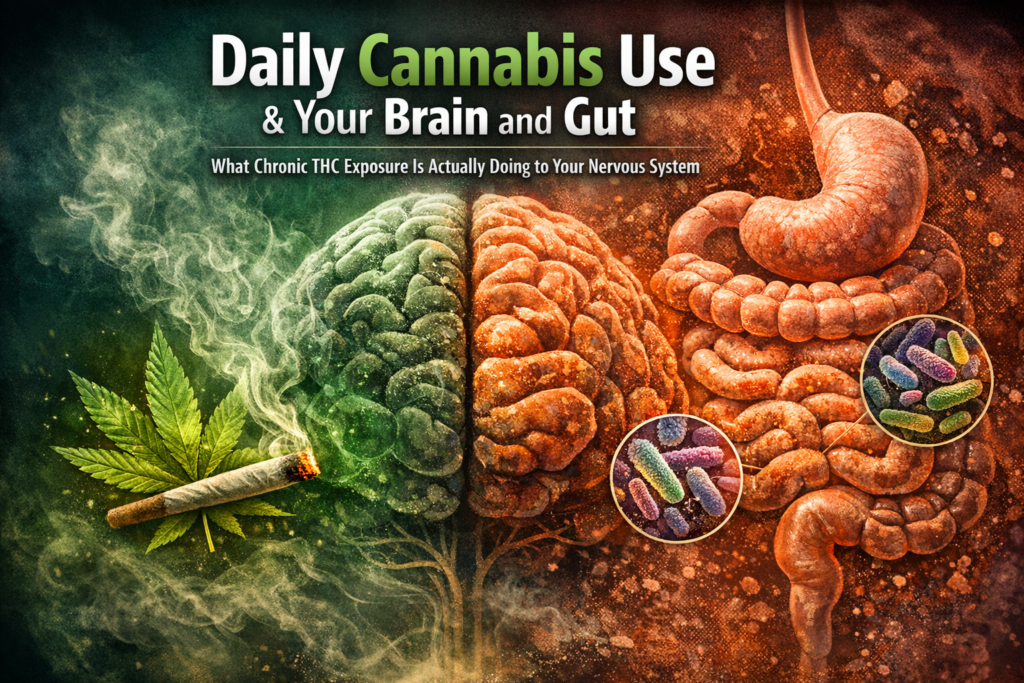
Why Daily Cannabis Use Is a Different Biological Event
Cannabis today is not the cannabis most people were introduced to.
Over the last two decades, THC potency has climbed substantially in many markets and product categories, while patterns of use have shifted toward daily and multi-daily exposure. 1
At a biological level, this matters.
Smoking occasionally is a transient neurochemical event.
Smoking daily becomes a persistent signaling environment the brain and gut must adapt to.
The nervous system does not distinguish between “medical,” “recreational,” or “coping.”
It responds to dose, frequency, and duration.
2
The question becomes:
What systems are now compensating for its constant presence?
Daily cannabis use rarely causes dramatic collapse. Instead, it produces slow adaptive shifts across:
- Stress regulation (HPA-axis tone)
- Reward processing (motivation and drive)
- Sleep architecture (sedation vs restoration)
- Gut signaling (motility, sensitivity, immune tone)
- Emotional resilience (baseline range and reactivity)
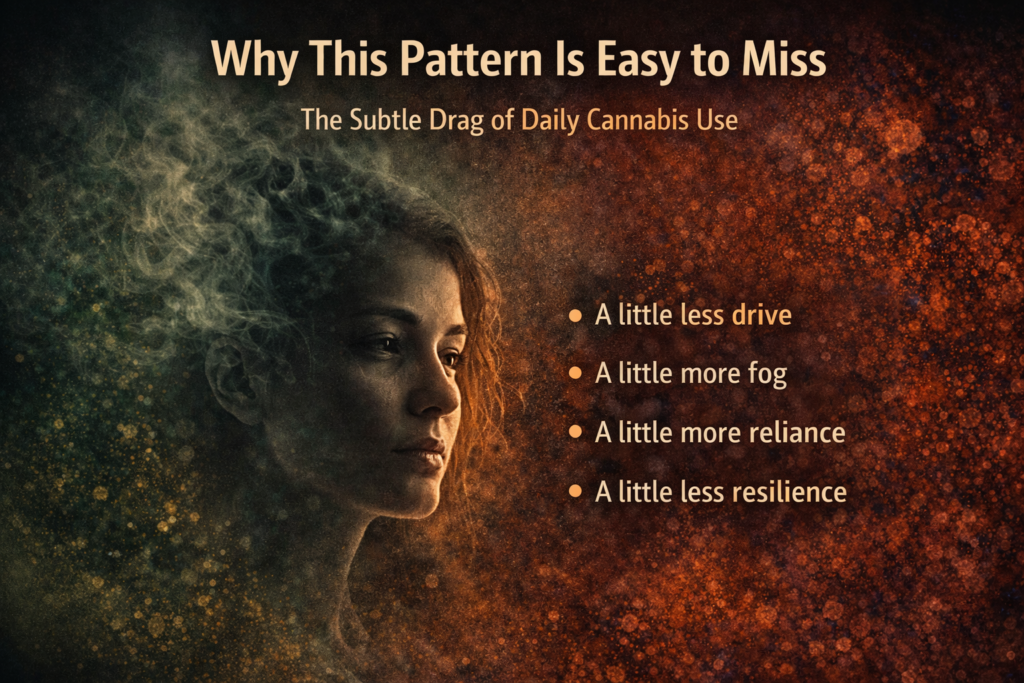
Nothing breaks loudly. Everything adjusts quietly.
That quiet adjustment is the story this article is actually about.
The Endocannabinoid System: The Regulatory Network THC Hijacks
Cannabis doesn’t invent a new pathway in your body.
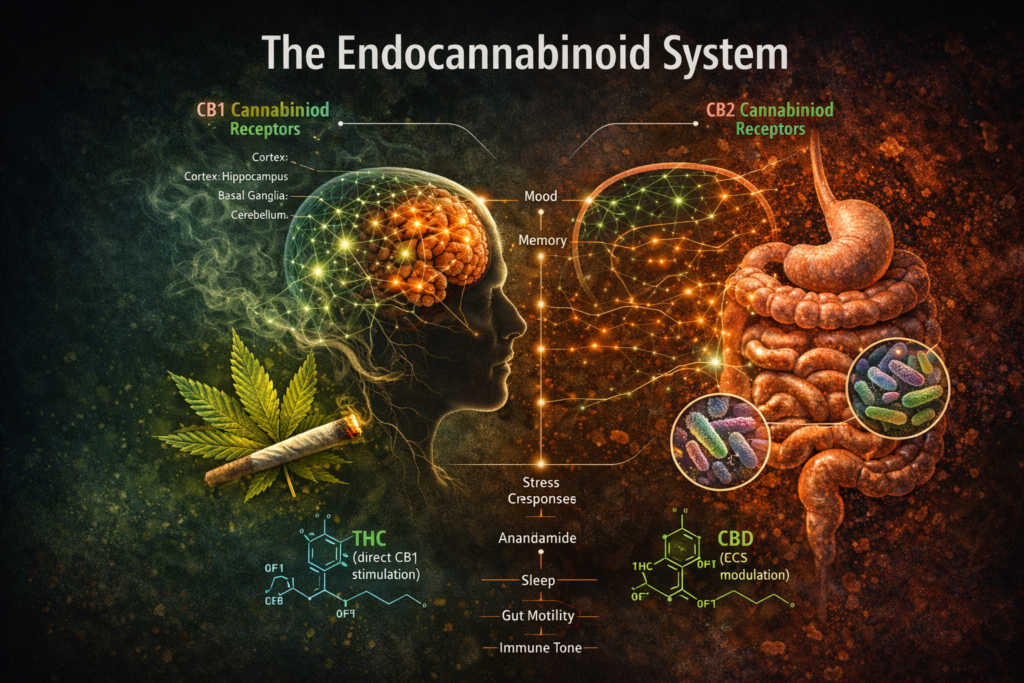
It plugs into an existing one—your endocannabinoid system (ECS). Before THC ever shows up, your nervous system already produces its own cannabinoids (like anandamide and 2-AG) to regulate stress, mood, sleep, appetite, immunity, and gut function.2
The ECS isn’t there to make you feel “good.” It’s there to keep you stable.
Think of it less like a pleasure system and more like a biological dimmer switch: it reduces extremes, buffers chaos, and helps the brain and body return to baseline.2
Daily THC turns that homeostasis system into a workaround.
CB1 and CB2: Where the system lives
- memory drift
- motivation changes
- reward flattening
- executive function drag
Here’s the part that matters for daily use: THC is a direct CB1 agonist.5 It doesn’t politely ask the system to adjust—it forces receptor activation far beyond normal physiological signaling ranges.
CBD doesn’t do this in the same way. And your body’s own cannabinoids don’t do this, either.
So when THC becomes a daily input, the ECS starts doing what every biological system does under chronic pressure: it adapts.
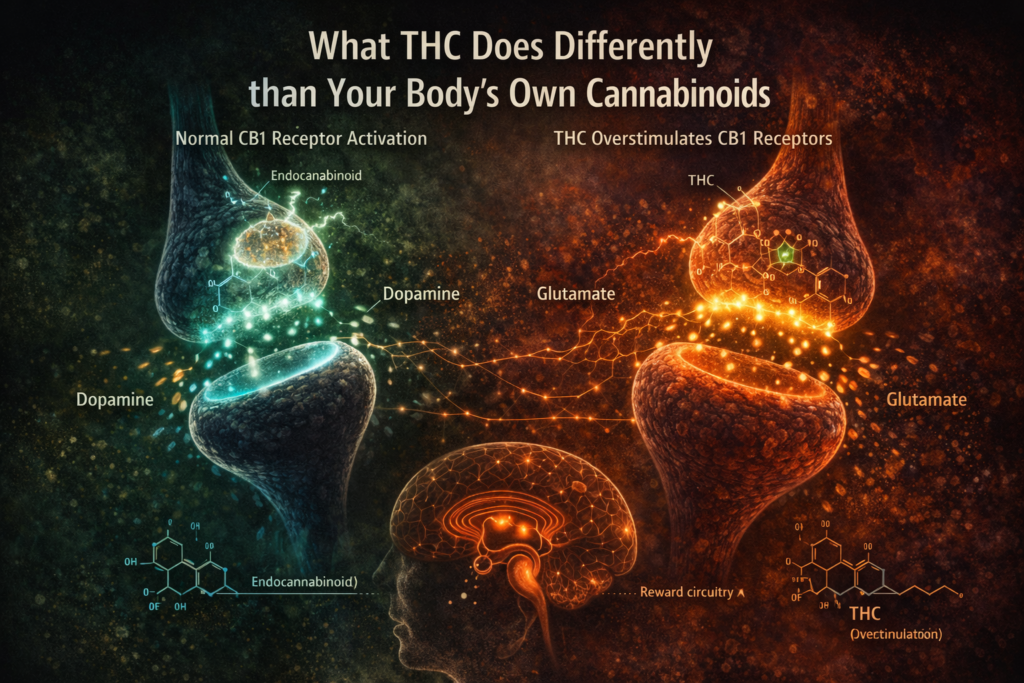
What THC Does Differently: Forced Signaling and the Start of Neuroadaptation
Your body’s own cannabinoids are short-lived and self-regulating. They rise when needed, do their job, then get broken down.
THC doesn’t follow those rules.
THC binds to CB1 receptors and drives activation hard enough, and long enough, that the system has to compensate to protect itself.6
That compensation is the beginning of the “it doesn’t hit like it used to” phase— not because you’re broken, but because your receptor system is doing exactly what adaptive biology does under chronic pressure.
And constant stimulus forces the brain to reduce sensitivity just to maintain baseline.
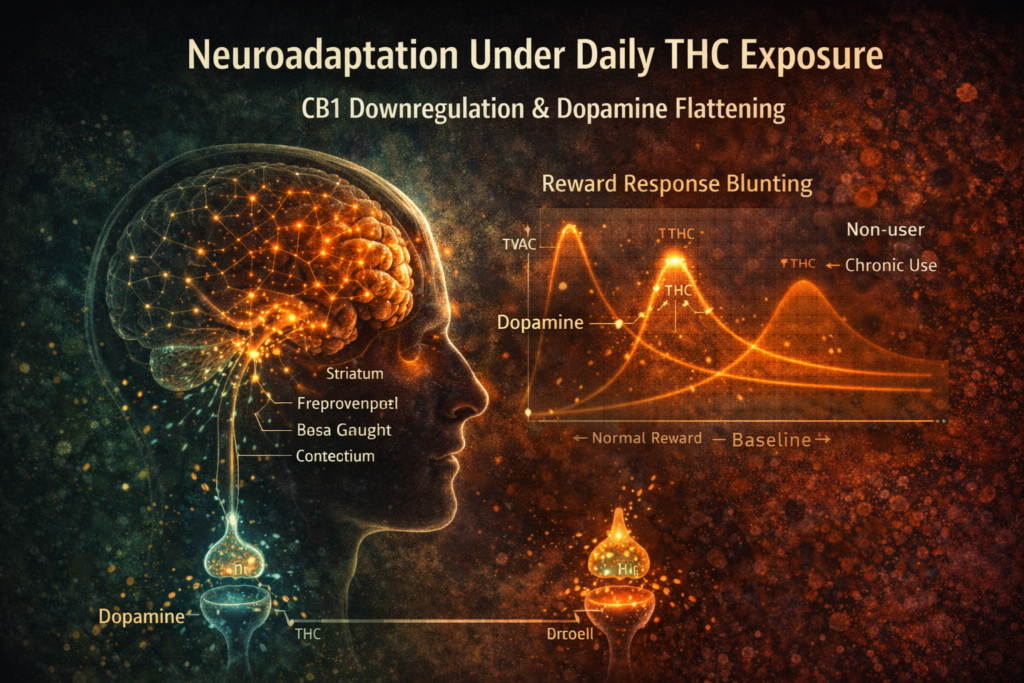
CB1 downregulation: why “normal” starts requiring THC
With sustained use, CB1 receptors can downregulate (fewer available receptors / reduced responsiveness), which is consistently observed in human studies and appears to recover—at least partially—after abstinence. 7
This is the point where many daily users stop getting a “high” and start getting a baseline.
- The first session feels like relief, not elevation
- Motivation feels delayed until after use
- Emotional range narrows (quiet, but flatter)
- Irritability shows up between sessions
None of this requires a dramatic “addiction story.” It can be explained by receptor math and the brain’s obsession with efficiency.
Dopamine flattening: when reward gets quieter
CB1 signaling intersects with dopamine circuitry. When CB1 stimulation is chronic, the reward system can become less responsive—meaning the contrast between “good” and “great” shrinks, and baseline motivation becomes harder to access without the same input. 8
This is why daily THC can feel like it’s helping you function—while quietly training the brain to require it for drive, pleasure, and stress buffering.
The shift is rarely explosive.
It’s cumulative.
Memory and Executive Function: The Quiet Cognitive Tax of Daily THC
Daily cannabis use doesn’t usually “wipe” memory. It chips at the mechanics that make memory usable: attention, working memory, and executive control. And those mechanics are heavily CB1-rich. 9
When THC repeatedly drives CB1 signaling, the brain adapts. That adaptation can show up as subtle performance changes—especially in tasks that require holding information online, switching focus, and finishing what you started. 10
This is where people get gaslit by their own experience. Because it doesn’t feel like “cognitive decline.” It feels like being scattered.
It’s that your brain starts dropping tabs.
Working memory: the mid-sentence blackout effect
Working memory is your brain’s temporary scratchpad. It’s what lets you hold a thought long enough to finish the sentence, follow a conversation, or complete a sequence. Chronic cannabis exposure is associated with impairments in working memory performance, particularly with heavier and more frequent use. 11
- Forgetting what you were saying mid-sentence
- Walking into a room and losing the reason
- Needing re-reads to absorb basic info
- Feeling “present” but not retaining
None of these are proof of permanent damage. They’re signs of a system running with different defaults.
Executive function: planning, task completion, and momentum
Executive function is the brain’s ability to organize behavior over time: planning, sequencing, prioritizing, resisting distraction, completing tasks. Regular cannabis use—especially heavy use—has been associated with differences in executive functioning and attention regulation across studies. 12
The lived experience often looks like:
- Starting projects with intensity, then abandoning them
- Feeling “motivated” after using but struggling to sustain momentum
- Procrastination that feels like fatigue, not laziness
- Needing THC to initiate, and then needing more to stay in it
That last line is important. Daily THC can quietly convert motivation into a state-dependent phenomenon: drive becomes easier inside the intoxicated state than outside it.
The Anxiety Paradox: Why Daily THC Can Lower Stress Today and Raise It Tomorrow
Cannabis can reduce anxiety during intoxication. That part is real.
But heavy daily use has also been associated with higher baseline anxiety and anxiety disorders in some populations, especially with earlier initiation, higher potency exposure, and frequent use patterns. 14
This is the paradox: a drug can provide acute relief while shaping the nervous system in a way that increases the need for that relief.
Daily THC can make your baseline nervous system more dependent on that quiet.
What’s happening under the hood
Multiple systems sit underneath this pattern:
- Dopamine flattening can reduce reward sensitivity and resilience, making stress feel sharper when sober. 8
- Glutamate / GABA balance can shift with repeated cannabinoid exposure, influencing arousal and threat perception. 15
- ECS tone changes (receptor downregulation + reduced endogenous signaling) can alter baseline stress buffering. 7
You don’t need all of these to be true at once. One is enough to create the “why am I anxious when I’m not high?” effect.
stress, overstimulation, gut discomfort, insomnia
acute relief, quieter mind, softened body
irritability, tension, anxious edge returns
relief becomes requirement
Who’s most likely to get caught in it
This pattern is especially common when cannabis is being used as self-medication for:
- chronic stress / burnout
- trauma load
- IBS-type gut sensitivity
- sleep onset issues
Again: the relief is real. The issue is that daily use can slowly train the nervous system to treat relief as something it can only access through THC.
Sleep on THC: Sedation Isn’t Restoration
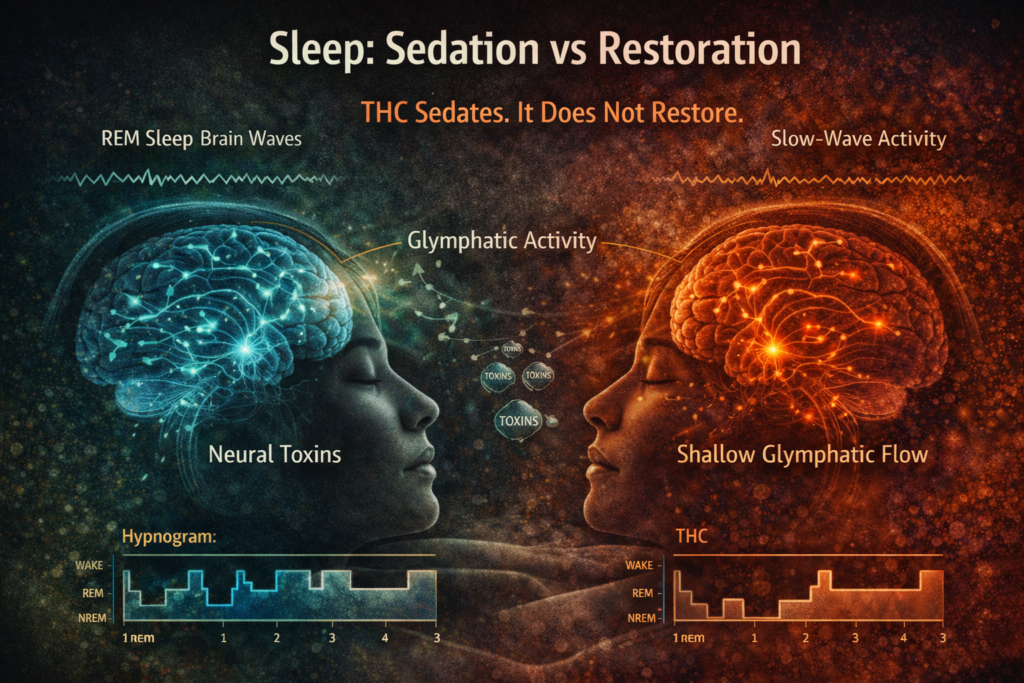
THC can make it easier to fall asleep. That effect is reliable enough that many people begin using cannabis primarily as a sleep aid. 16
But falling asleep faster is not the same thing as sleeping better. Sleep quality is defined by architecture—how the brain cycles through light sleep, deep sleep, and REM across the night.
This is where chronic THC use quietly changes the equation.
It does not guarantee the brain does its nightly repair work.
REM suppression and emotional processing
Repeated THC exposure has been shown to suppress REM sleep, particularly with higher doses and chronic use. 17
REM sleep is not optional. It plays a central role in:
- emotional regulation
- memory consolidation
- stress processing and fear extinction
When REM is chronically blunted, mood stability and stress tolerance can quietly erode— even if total sleep time looks “fine” on paper.
Deep sleep, brain cleanup, and the glymphatic system
Deep non-REM sleep supports the brain’s glymphatic system— a clearance pathway that helps remove metabolic waste and inflammatory byproducts overnight. 18
While research is still evolving, altered sleep architecture associated with chronic THC use may interfere with optimal glymphatic flow, especially when sleep becomes more sedative than cyclical.
This matters because poor brain clearance doesn’t show up immediately. It shows up as slower recovery, brain fog, emotional volatility, and reduced resilience over time.
- rebound insomnia
- vivid or intense dreams
- restlessness and night awakenings
- anxiety spikes at bedtime
This isn’t proof that cannabis “fixed” sleep. It’s evidence that sleep architecture adapted to its presence. 19
Cannabis and the Gut–Brain Axis: Symptom Relief vs. Systemic Trade-Offs
Cannabis can reduce gut discomfort. That’s not placebo—endocannabinoid signaling directly influences motility, visceral pain perception, immune activity, and nausea pathways. 20
This is why people with IBS-type symptoms, functional gut disorders, or stress-sensitive digestion often experience real relief with THC.
But relief is not the same thing as repair.
Comfort does not equal correction.
What the endocannabinoid system does in the gut
CB1 and CB2 receptors are expressed throughout the gastrointestinal tract and enteric nervous system. Their activation can:
- slow gut motility
- reduce visceral pain signaling
- modulate immune activation
- dampen stress-induced gut reactivity
In the short term, this can feel stabilizing—especially in a nervous system already running hot.
The microbiome question (where things get subtle)
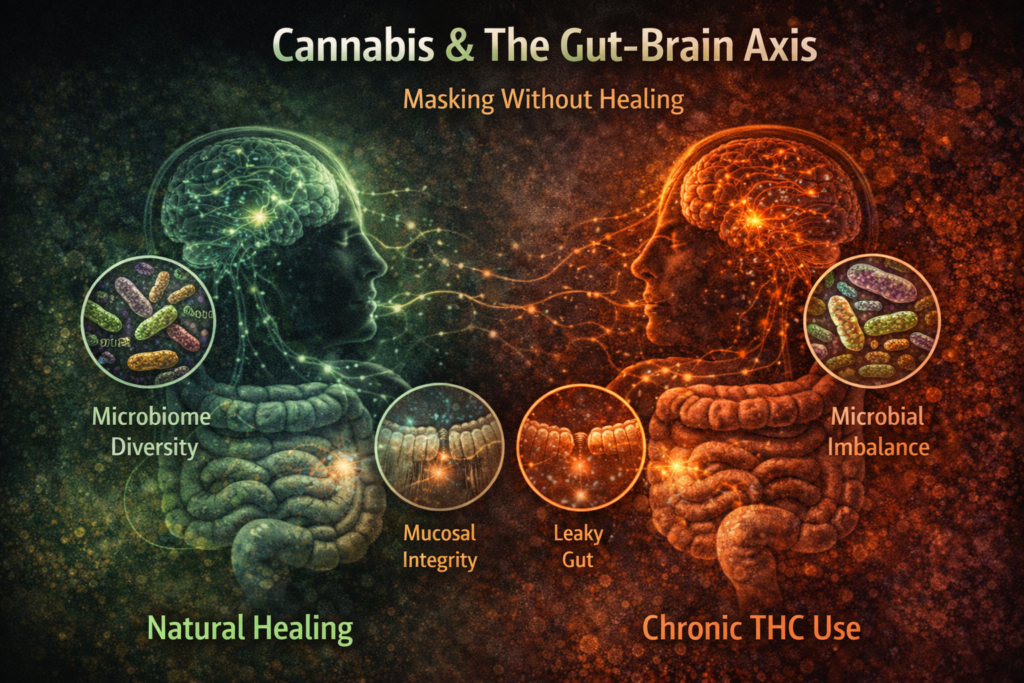
Emerging research suggests chronic cannabis exposure may be associated with changes in gut microbiome composition, including shifts in diversity and relative abundance of key taxa. 21
The data is still evolving, but the direction is consistent: when gut signaling is repeatedly dampened, feedback from the microbiome to the brain can change.
This matters because microbial signals influence:
- neurotransmitter production
- inflammatory tone
- stress reactivity
- craving and reward behavior
Gut permeability, cravings, and masking
Under stress, altered ECS signaling may influence intestinal permeability and immune response, particularly when paired with poor sleep, low fiber intake, or chronic sympathetic activation. 22
At the same time, THC’s effects on appetite and reward can amplify cravings—especially for refined carbohydrates that further shape microbial balance.
The net effect is a masking phenomenon: symptoms feel quieter while upstream drivers continue to operate.
Dependence vs. Addiction: What Daily Cannabis Use Actually Creates
Cannabis is often described as “non-addictive.” What that usually means is that it does not produce the same acute, life-threatening withdrawal seen with alcohol or opioids.
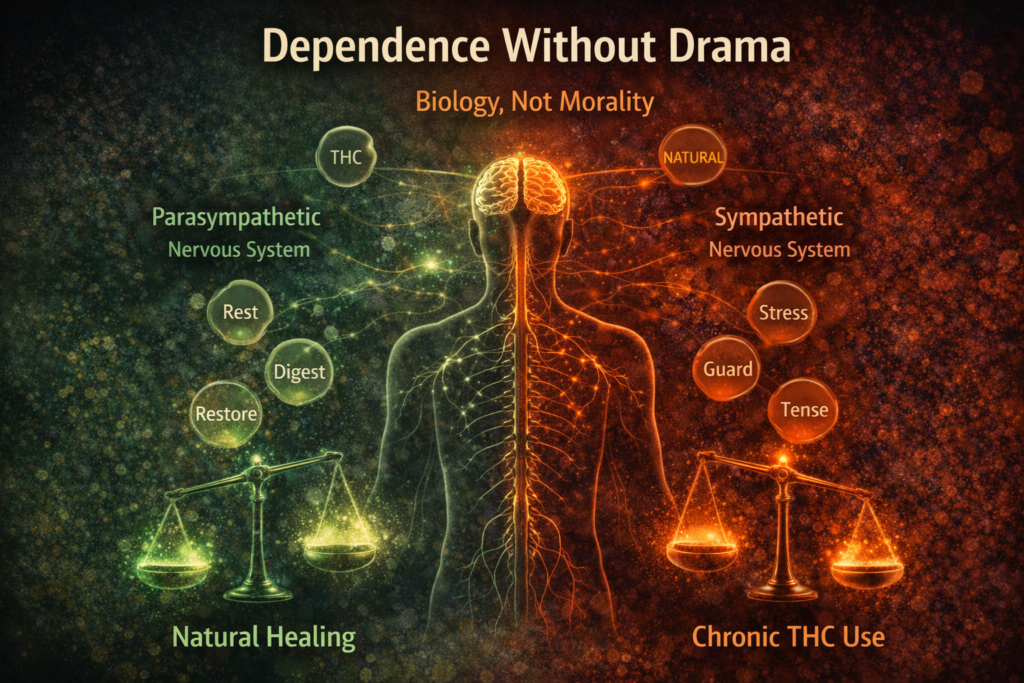
That does not mean it cannot create dependence. Dependence simply means the nervous system has adapted to the regular presence of a substance and now functions differently without it. 23
This distinction matters—because dependence is biological, not moral.
It means your nervous system learned a new baseline.
What withdrawal actually looks like
When daily cannabis use stops, the most common symptoms are not dramatic—they’re regulatory. They reflect a nervous system recalibrating ECS tone, dopamine signaling, and stress response. 24
- irritability
- restlessness
- anxiety spikes
- sleep disruption
- appetite changes
These symptoms are usually time-limited, but they’re enough to pull people back into the loop— not because they’re “addicted,” but because the body prefers familiarity.
Why daily use makes stopping feel harder than expected
Daily THC use doesn’t just change receptors. It changes routines, sleep timing, stress buffering, appetite cues, and emotional regulation.
Over time, THC becomes woven into multiple regulatory loops:
- sleep initiation
- stress comedown
- emotional numbing
- reward and motivation access
Removing it can temporarily expose the deficits that were being masked. That doesn’t mean THC caused those deficits—it means it was compensating for them.
Harm Reduction Without Bullshit: Protecting Your Brain and Gut as a Daily User
Harm reduction isn’t about pretending daily cannabis use has no consequences. It’s about reducing the biological cost of those consequences.
If THC is part of your routine, the goal is not perfection. The goal is protecting the systems that take the hit first: dopamine, sleep architecture, stress regulation, and the gut–brain axis.
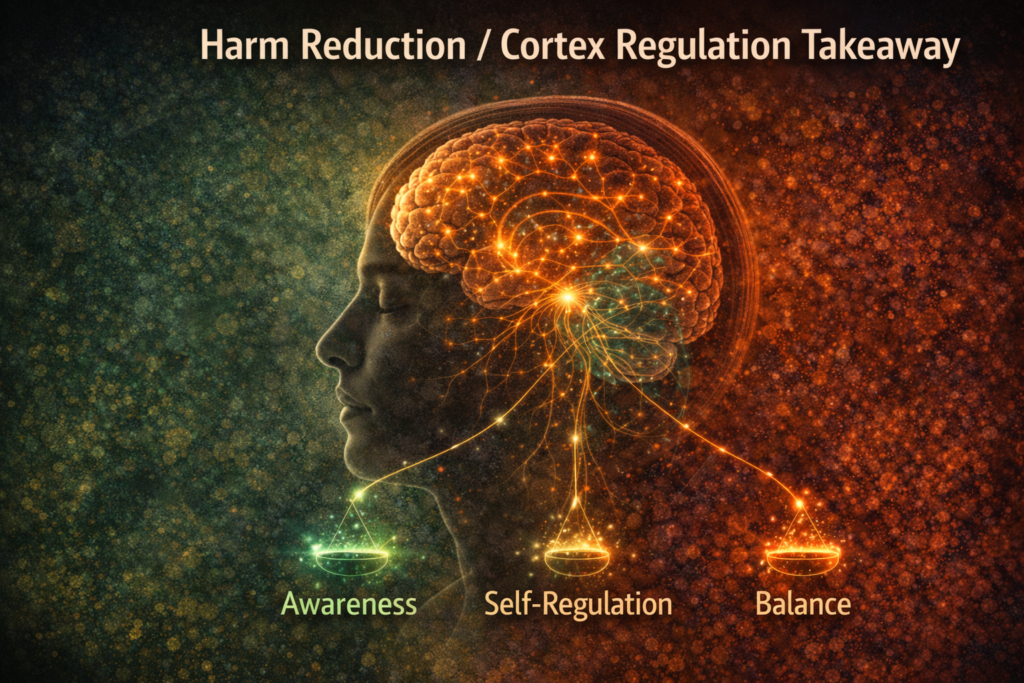
Cortex Cannibal Takeaway: Awareness Is the Intervention
Cannabis is not harmless. And it is not evil.
Used occasionally, it may be neutral—or even helpful—for symptom relief in the right context. 20 Used heavily and daily, it reshapes brain chemistry, stress regulation, sleep architecture, and gut ecology—quietly, cumulatively, and predictably. 7 17 21
The damage is rarely dramatic. The drag is.
If you’re a daily user, the question isn’t “Should I be ashamed?” The question is:
If THC is your sleep switch, rebuild sleep hygiene and circadian anchors. 16
If THC is your stress buffer, rebuild nervous system regulation and HPA resilience. 14
If THC is your gut quieting mechanism, rebuild microbial support and reduce the upstream stress load that drives gut reactivity. 22
That’s the Cortex Cannibal lane: no moral panic, no stoner mythology—just physiology, truth, and leverage.
References
Citation numbers in the article link to these sources. When you click a number, the matching reference will scroll into view and highlight.
Note: Some entries link to PubMed search results to keep links stable while still pointing to the relevant peer-reviewed literature.
- National Institute on Drug Abuse (NIDA). Cannabis (Marijuana) Potency Data. Source · Back to top
- NCBI Bookshelf (NIH/NCBI). The Endocannabinoid System: Overview (search results). Source · Back to top
- PubMed. CB1 receptors in cortex/hippocampus/basal ganglia + cognition/motivation (search). Source · Back to top
- Frontiers in Immunology. CB2 receptors, immunity, and gut inflammation (journal search). Source · Back to top
- PubMed. THC CB1 agonist binding affinity / receptor activation (search). Source · Back to top
- PubMed. THC CB1 receptor activation + chronic exposure neuroadaptation (search). Source · Back to top
- PubMed. CB1 receptor downregulation / recovery after abstinence (PET studies) (search). Source · Back to top
- PubMed. Cannabinoids dopamine reward circuitry blunting (search). Source · Back to top
- PubMed. CB1 receptor distribution + cognition/executive function (search). Source · Back to top
- PubMed. Daily/heavy cannabis use attention processing speed executive function (search). Source · Back to top
- PubMed. Cannabis working memory impairment dose frequency dependent (search). Source · Back to top
- PubMed. Cannabis executive dysfunction planning task completion (search). Source · Back to top
- PubMed. Cognitive effects of cannabis reversibility after abstinence (search). Source · Back to top
- Canadian Centre for Addiction and Mental Health (CAMH). Cannabis and mental health / anxiety (resource hub). Source · Back to top
- PubMed. Cannabinoids glutamate GABA anxiety arousal (search). Source · Back to top
- PubMed. Cannabis sleep onset latency total sleep time (search). Source · Back to top
- PubMed. THC REM sleep suppression chronic use (search). Source · Back to top
- NIH/NCBI. Glymphatic system and brain waste clearance (search). Source · Back to top
- PubMed. Cannabis withdrawal insomnia vivid dreams (search). Source · Back to top
- PubMed. Endocannabinoid system gut motility visceral pain nausea (search). Source · Back to top
- PubMed. Cannabis use microbiome composition diversity (search). Source · Back to top
- PubMed. Stress intestinal permeability endocannabinoid system (search). Source · Back to top
- American Psychiatric Association (APA). DSM-5-TR overview / diagnostic framework. Source · Back to top
- PubMed. Cannabis withdrawal syndrome symptoms timeline (search). Source · Back to top
- PubMed. Cannabis circadian rhythm dopamine morning use wake and bake (search). Source · Back to top
- NIDA. Cannabis Concentrates (high-THC products) and risks (topic page/search). Source · Back to top
- PubMed. Cannabidiol (CBD) anxiety THC buffering (search). Source · Back to top
- NIH Office of Dietary Supplements. Magnesium — Fact Sheet for Health Professionals. Source · Back to top