
Cortex Cannibal · Body & Biology
Perimenopause Anxiety at Night
Why Am I Awake
at 3 a.m.?
Exhausted all day. Wide awake at three. Apparently, your body has other plans.

Inside this article
Why does perimenopause anxiety at night have you wide awake when you’ve been exhausted all day? It’s three in the morning, your heart is pounding, and you can’t work out what you’re anxious about. Beside you, your partner rolls over and goes straight back to sleep. You briefly consider smothering him. Then he starts snoring. Brave.
You spent half the day wishing you could crawl into bed. Now you’re finally there, with nowhere to be and nothing to do, and your body has decided it’s time to be fucking terrified.
Within minutes, your brain starts supplying possible reasons. Money. Your kid. That appointment you haven’t booked. Whether the strange feeling in your chest is something serious. You check the time and calculate how much sleep you could still get, which somehow becomes another thing to worry about.
Anxiety, sleep difficulties and palpitations can all occur during the menopause transition.[1] Perimenopause could be part of what’s happening, but you deserve an explanation that goes further than “hormones” and a suggestion to have a bath.
Sometimes your body gets there before the worry
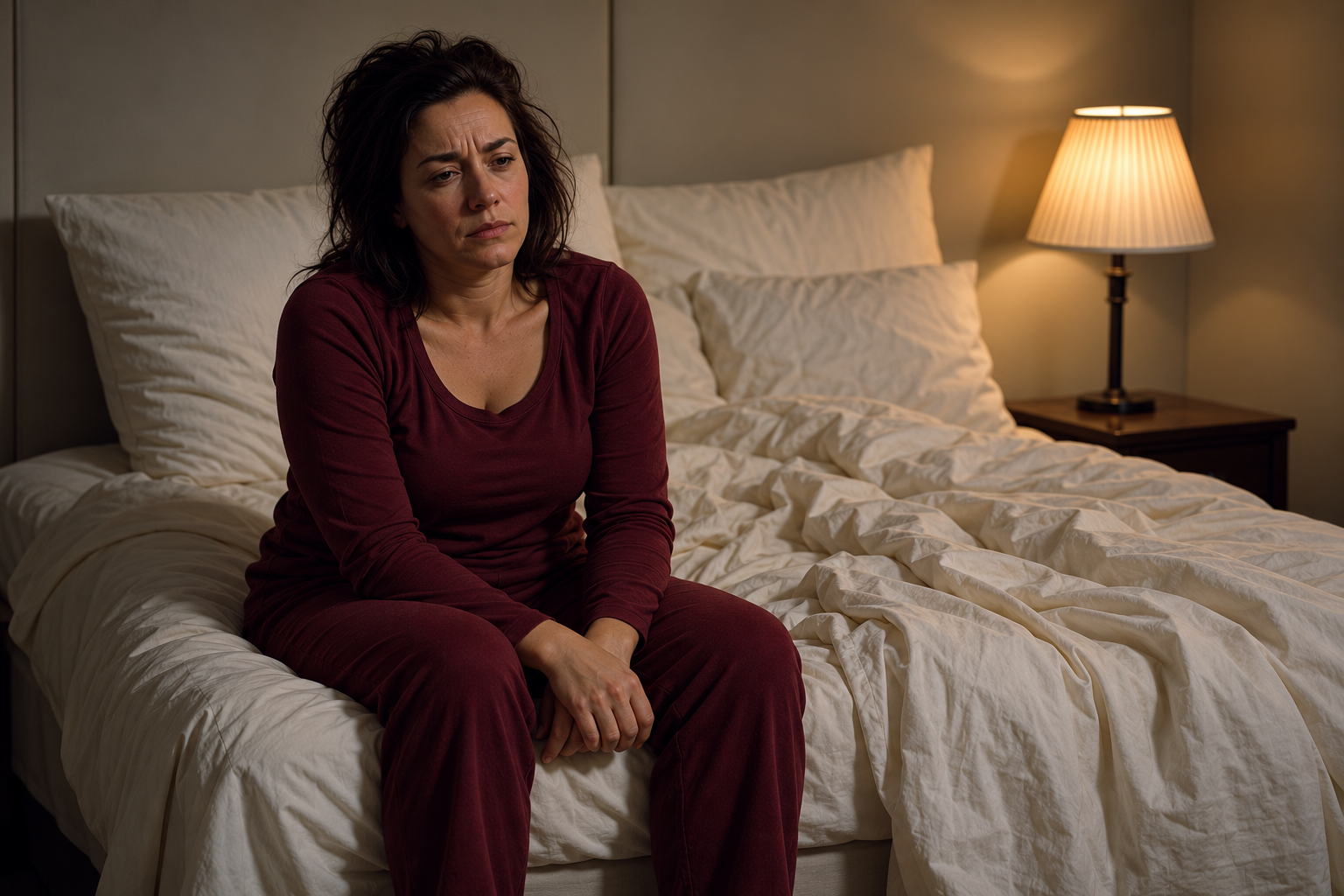
There’s a difference between lying awake worrying about something and waking up already feeling alarmed. In the second version, you may find yourself searching for an explanation because the sensation is there first. Your brain has plenty of material available. Unfortunately, none of it is particularly reassuring at three in the morning.
Then you start worrying about tomorrow. You know how much patience you’ll have after four hours of sleep. You’re mentally cancelling exercise, calculating how much coffee you’ll need and wondering whether anyone will require you to be pleasant.
That describes an experience, rather than establishing its cause. A pounding heart, anxious thoughts and interrupted sleep can arrive together without telling you which started the problem. The distinction matters because “I woke up feeling anxious” doesn’t automatically explain why you woke.
How perimenopause can affect anxiety and sleep
Estrogen and progesterone interact with brain systems involved in mood and sleep. During perimenopause, their patterns become less predictable, and some women experience anxiety or sleep difficulties alongside those changes. The effects vary considerably between people.[1][2]
One substance scientists are interested in is allopregnanolone, which your body makes from progesterone. It influences GABA-A receptors, part of the system that helps regulate how excitable brain cells are. GABA acts as an inhibitory messenger, helping reduce activity rather than encouraging every signal to keep going.[2]
Researchers are investigating whether sensitivity to changing allopregnanolone levels contributes to mood symptoms during reproductive transitions. Evidence specific to the menopause transition is limited and inconsistent. It’s a possible mechanism, not proof that your progesterone dropped and caused last night’s panic.[2]
Which is annoying when you’d quite like a definite answer. Still, uncertainty about the mechanism doesn’t mean the experience is imaginary. Reproductive hormones have influence beyond your periods, and changes in how you feel deserve attention.
Sometimes a hot flash brings company
Waking sweaty is unpleasant enough. Waking sweaty with a pounding heart gives you something else to investigate while you look for a dry patch of pillow.
Hot flashes can involve changes in the nervous system’s control of the heart. In a study of 215 midlife women, researchers recorded reduced cardiac vagal activity during hot flashes. That’s the influence that normally helps slow the heartbeat, and the changes were particularly pronounced during sleep.[3]
This offers one possible route to waking with physical sensations you find alarming. It doesn’t establish that every anxious awakening is a hot flash you failed to notice. But heat, a noticeable heartbeat and disrupted sleep can belong to the same event.
You may have been sleeping quite peacefully before any of this happened. That’s worth remembering before you blame yourself for somehow failing to relax properly.
About that cortisol explanation
Three a.m. isn’t a cortisol diagnosis
“It’s a cortisol spike” gets offered with remarkable confidence considering nobody has measured anything.
The time on the clock cannot tell you your cortisol level or establish what caused the awakening. A small experimental study using a pharmacological model of menopause examined how fragmented sleep and estradiol suppression affected cortisol patterns. Sleep fragmentation increased bedtime cortisol and reduced the cortisol awakening response. It did not establish what causes spontaneous 3 a.m. anxiety during natural perimenopause.[4]
More useful details include whether you’re sweating, how your heartbeat feels, how frequently this happens and what else has changed. Those observations give a clinician something to work with. Knowing it happened at 3:07 mostly tells you how long you’ve been staring at the ceiling.
You were asleep.
That was the relaxing part.
What might actually help?
Start with what’s waking you
If heat is waking you, a cooler room and lighter bedding are reasonable starting points. Regular sleep habits and reducing caffeine and alcohol may also help.[5] These suggestions have a place, but persistent symptoms deserve more attention than another bedtime checklist.
Notice the pattern
Keep a brief record if you can: awakenings, sweating, palpitations and changes in your periods. It doesn’t need to become a spreadsheet. You’re trying to describe a pattern, not give yourself an administrative position you didn’t apply for.
Ask about treatment
If this keeps happening, ask about treatment. Hormone therapy is the most effective treatment for menopausal hot flashes and night sweats, and it can improve sleep when those symptoms cause awakenings. Whether it suits you depends on your symptoms, medical history and individual risks. Those benefits don’t automatically establish that it treats anxiety itself.[6]
Menopause-specific cognitive behavioural therapy is another option for sleep problems associated with hot flashes and night sweats. NICE includes it among the available management choices.[7] If anxiety is also affecting your days, bring that up too, so it can be assessed alongside the sleep problem.

“Probably hormones” shouldn’t end the conversation
Palpitations can occur around menopause, but that doesn’t establish the cause of yours. Tell a healthcare professional about new, recurring or changing symptoms. If palpitations come with chest pain, shortness of breath, fainting or feeling as though you might faint, seek emergency care.[8]
You can suspect perimenopause and still expect someone to consider other explanations. Your age is relevant information. It shouldn’t be the point where everyone stops asking questions.
Something to carry with you
Cortex Takeaway
Being exhausted all day and wide awake at night is frustrating enough without feeling responsible for fixing it through sheer dedication to bedtime. You’re allowed to be annoyed. You’re also allowed to ask for more help.
Perimenopause may explain part of the pattern, but you don’t have to diagnose yourself from under the duvet. Bring the symptoms to someone who can assess them. You deserve to spend less of the night wondering what’s wrong and more of it doing the thing you went to bed for.
A few quick questions
Still wondering?
Can perimenopause cause anxiety if I never used to feel this way?
Anxiety can occur during the menopause transition, including when it feels unfamiliar. A new pattern deserves assessment rather than automatically being attributed to hormones.[1]
Does waking at 3 a.m. mean my cortisol is too high?
No. The timing alone cannot establish your cortisol level or explain why you woke up.
References
- NHS. Symptoms of menopause and perimenopause [Internet]. Reviewed 2026 May 19 [cited 2026 Oct 30]. Read the patient information.
- McEvoy K, Osborne LM. Allopregnanolone and reproductive psychiatry: an overview. Int Rev Psychiatry. 2019;31(3):237–244. doi:10.1080/09540261.2018.1553775. Read the full review. Evidence specific to the menopause transition is limited and inconsistent.
- Thurston RC, Matthews KA, Chang Y, Santoro N, Barinas-Mitchell E, von Känel R, et al. Changes in heart rate variability during vasomotor symptoms among midlife women. Menopause. 2016;23(5):499–505. doi:10.1097/GME.0000000000000586. Read the full paper. Observational physiological monitoring of 215 women.
- Cohn AY, Grant LK, Nathan MD, Wiley A, Abramson M, Harder JA, et al. Effects of sleep fragmentation and estradiol decline on cortisol in a human experimental model of menopause. J Clin Endocrinol Metab. 2023;108(11):e1347–e1357. doi:10.1210/clinem/dgad285. Read the full paper. Experimental hormone suppression and sleep fragmentation, rather than natural perimenopause.
- NHS. Things you can do to help menopause and perimenopause symptoms [Internet]. Reviewed 2026 May 19 [cited 2026 Oct 30]. Read the patient information.
- The North American Menopause Society. The 2022 hormone therapy position statement of The North American Menopause Society. Menopause. 2022;29(7):767–794. doi:10.1097/GME.0000000000002028. Read the position statement PDF.
- National Institute for Health and Care Excellence. Menopause: identification and management. NICE guideline NG23 [Internet]. [cited 2026 Oct 30]. Read the recommendations. Recommendation 1.5.24 addresses menopause-specific CBT for sleep problems associated with vasomotor symptoms.
- Cleveland Clinic. Heart palpitations [Internet]. Reviewed 2022 Sep 16 [cited 2026 Oct 30]. Read the clinical patient information. Includes assessment advice and emergency warning signs.
This article provides general education, not a diagnosis or individual treatment advice. The scenarios are illustrative, the pull quote is original Cortex Cannibal writing, and the images are AI-generated editorial illustrations. Read the Medical Disclaimer.
A little further down the rabbit hole
Read next ↗
Another familiar human experience with more going on beneath the surface.