
I Started Taking Creatine. Then I Got Curious About My Brain.
Creatine has spent decades building its reputation in gyms. Meanwhile, your brain has been using it all along.
APPROX. 12 MIN READ
Your Brain Is Ridiculously Expensive to Run
Your brain makes up roughly 2% of your body weight, yet accounts for about 20% of your body's oxygen consumption at rest. That's an impressive energy budget for something that occasionally forgets why it walked into the kitchen.
But while you're standing there trying to remember what you came for, billions of neurons are maintaining electrical gradients, exchanging signals, and keeping their internal machinery running.
Even when you're doing absolutely nothing productive, your brain is working.
Much of that activity depends on adenosine triphosphate, better known as ATP. It's the molecule cells use to power countless processes, including the work required to maintain the electrical conditions that allow neurons to communicate.
And ATP isn't something your cells keep in an enormous emergency stockpile. It's constantly being used and regenerated.
The brain is especially sensitive to disruptions in its energy supply. Neurons need a dependable way to meet changing demands, whether they're processing sensory information, coordinating movement, or helping you remember where you left your phone.
Which brings us to creatine.
Apparently, Creatine Has Been Working in My Brain This Entire Time
Creatine is a naturally occurring compound your body makes from amino-acid precursors. You also obtain some through foods such as meat and fish.
Most of the body's creatine is found in skeletal muscle, which explains its long-standing relationship with gym culture. But creatine is also present in the brain, heart, and other tissues that need a reliable energy supply.
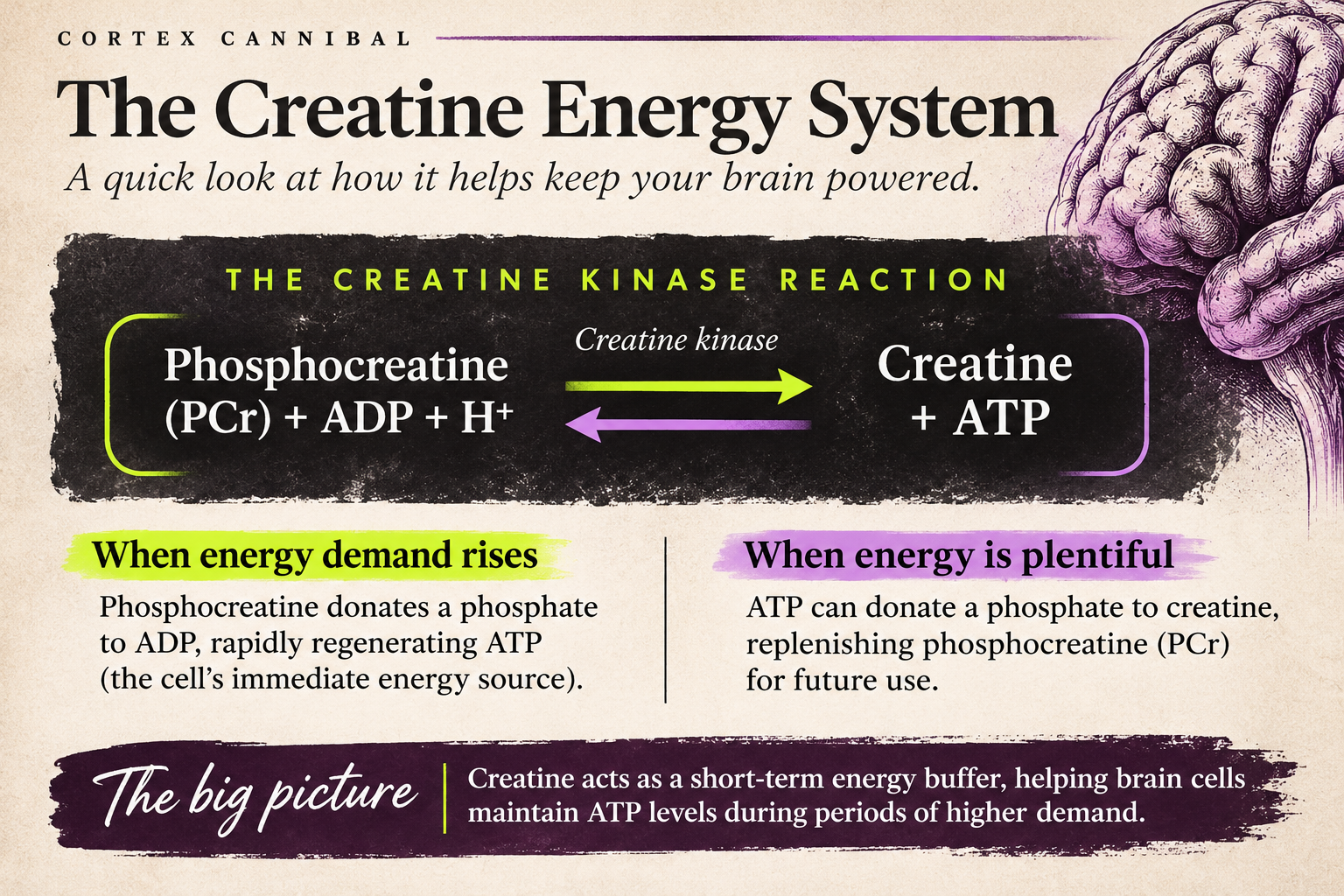
Inside cells, some creatine is converted into phosphocreatine.
When ATP is being used rapidly, phosphocreatine can donate a phosphate group to help regenerate it. An enzyme called creatine kinase makes that exchange possible.
Think of it as a rapidly available backup system that helps cells manage sudden changes in energy demand.
It doesn't create energy out of nowhere, and it doesn't replace the metabolic pathways that produce ATP. It helps buffer and transfer energy within an existing system.
That's particularly useful in neurons, where maintaining electrical activity is a continuous job.
Every time a neuron sends a signal, the cell has to maintain and restore carefully controlled differences in charged particles across its membrane. That work requires energy.
And it happens over and over again.
So creatine has a legitimate biological role in the brain.
But knowing that the brain uses creatine doesn't automatically mean taking more of it will improve your memory, focus, or mood.
That's a pretty important distinction, considering how quickly a biological mechanism can become a supplement advertisement.
Your Muscles and Your Brain Don't Follow the Same Rules
Creatine has an established reputation in sports nutrition because supplementation can increase muscle creatine stores and improve performance in certain forms of high-intensity exercise.
The brain is more complicated.
For one thing, it has a blood-brain barrier, a highly selective system that helps regulate what moves from the bloodstream into brain tissue.
Creatine transport into the brain is controlled, and the brain can also produce some creatine locally.
That means swallowing creatine doesn't necessarily produce the same changes in brain creatine levels that it produces in muscle.
Some studies have measured increases in brain creatine following supplementation. Others have found smaller or inconsistent changes.
Researchers have used different doses, durations, populations, and measurement techniques, making the results difficult to compare.
This is where we have to separate what a substance does naturally from what happens when we take extra amounts of it.
The first question is about biology. The second requires human trials.
And those trials have produced some interesting findings.
Can Creatine Actually Improve Memory and Focus?
This is where things become less straightforward. Creatine has a plausible role in supporting brain energy metabolism, but a plausible mechanism isn't the same as proof that a supplement improves how we think.
A 2024 systematic review and meta-analysis pooled findings from 16 randomized controlled trials involving 492 participants. Researchers reported potential benefits in some measures of memory, attention time and processing speed, but the evidence varied by outcome and was limited by differences between studies.
That matters because cognition isn't one single ability. Remembering a list of words, reacting quickly to a visual signal and maintaining concentration through a demanding task are different things. An improvement in one doesn't automatically mean an improvement in all of them.
Some studies suggest certain groups may respond differently, including older adults or people under metabolic stress. But the available trials are generally small, and findings aren't consistent enough to claim that creatine reliably sharpens everyone's brain.
So, does creatine make you smarter? We don't have evidence to support that sweeping claim. Could it help particular cognitive tasks in particular circumstances? That's a much more reasonable question, and one researchers are still working through.
Scientists Have Been Giving Sleep-Deprived People Creatine
Of all the research directions I came across, this one caught my attention. Not because creatine is a substitute for sleep, but because sleep deprivation puts the brain under a very different kind of pressure than a normal, well-rested afternoon.
When we're short on sleep, attention, working memory and other cognitive functions can suffer. Researchers have been investigating whether supporting the brain's energy system might change how people perform under those conditions.

In a small 2024 study involving 15 participants, researchers investigated a single high dose of creatine during sleep deprivation. They reported changes in brain energy-related measurements alongside improvements in some cognitive performance measures over the observation period.
It's an intriguing result, particularly because the researchers were examining both brain metabolism and task performance rather than relying only on how alert participants said they felt.
But fifteen people is a very small study. It can't tell us whether the same response would occur consistently across larger groups, different ages or different health conditions.
And the dose used in that experiment was substantially higher than the amount many people take daily for exercise. We shouldn't treat an experimental sleep-deprivation protocol as everyday dosing advice.
The bigger question is whether these findings can be replicated and whether any measurable improvement is meaningful outside a controlled laboratory setting.
There's also an important distinction between helping someone perform on a task while sleep-deprived and improving their sleep. Those are not the same outcome.
Creatine hasn't been established as a treatment for insomnia, and none of this gives us permission to replace adequate sleep with a scoop of powder and blind optimism.
Could Brain Energy Have Something to Do With Mood?
Mood isn't just about neurotransmitters. Brain cells also depend on energy metabolism, and researchers have been investigating whether changes in cellular energy systems play a role in certain psychiatric conditions.
Creatine is part of that conversation because of its role in the phosphocreatine system. Researchers have explored whether supplementation might have an effect on depressive symptoms, sometimes alongside established treatments.
But this is not the same as saying creatine treats depression. Clinical studies have used different populations, doses and treatment approaches, and the overall evidence remains uncertain.
Some individual trials have reported encouraging findings. However, systematic reviews have not established a sufficiently reliable benefit to recommend creatine as a stand-alone treatment for depression.
There is also no convincing evidence that taking creatine will improve the mood of every otherwise healthy person.
My own mood felt better after I started several supplements together, but I can't isolate which one, if any, was responsible. That experience is worth being curious about. It isn't evidence of a treatment effect.
What About Brain Fog and Getting Older?
There's a particular kind of mental frustration that comes with knowing you used to be able to juggle a dozen things at once, only to find yourself standing in front of an open cupboard wondering what the hell you were looking for.
Midlife brain fog is a real concern for many people, particularly during the menopausal transition. Changes in sleep, stress, hormonal fluctuations and other health factors can all influence attention, memory and how mentally sharp we feel.

It's tempting to connect those experiences to creatine because the brain needs energy and some research has explored cognitive outcomes in older adults.
But midlife and older adulthood are not interchangeable research populations. Findings from a study of older adults cannot automatically be applied to people experiencing perimenopause.
And while researchers have proposed that creatine might be useful under certain conditions of increased energy demand, we do not yet have strong clinical evidence that supplementation reliably improves menopause-related brain fog.
That's an important gap. Brain fog isn't one disease with one cause, and the phrase can describe everything from poor concentration and forgetfulness to mental exhaustion.
For now, creatine remains an interesting research question rather than a proven answer to midlife cognitive changes.
Before We All Start Putting Creatine in Our Coffee
Creatine monohydrate is one of the more extensively studied sports supplements. For exercise-related use, a common maintenance amount is around 3 to 5 grams daily, although protocols vary.
But we shouldn't confuse a well-studied exercise dose with an established brain-health dose. Cognitive studies have used different amounts and durations, and researchers have not identified one universally effective supplementation protocol for memory, focus or mood.
Some experimental studies have used much larger doses. That doesn't mean more is better, or that copying a research protocol at home is a good idea.
Creatine is generally well tolerated by healthy adults at commonly studied doses. Possible adverse effects include gastrointestinal discomfort and weight gain associated with increased water retention.
People with kidney disease, abnormal kidney function or other significant medical conditions should discuss supplementation with a qualified healthcare professional. Creatine can also affect blood creatinine measurements, which may complicate the interpretation of some kidney function tests.
Pregnancy and breastfeeding are additional situations where routine supplementation for cognitive benefits is not supported by adequate safety evidence.
And if you're experiencing persistent brain fog, major changes in memory, low mood or ongoing exhaustion, those symptoms deserve proper assessment rather than an assumption that your brain needs more creatine.
Supplements can be worth studying. They shouldn't become an excuse to ignore what else might be going on.
The Weirdest Part Wasn't the Supplement
I went looking for an explanation for why I was feeling better, and instead found myself reading about ATP, phosphocreatine, neurons and the blood-brain barrier.
Which is a fairly typical way for my brain to turn one simple question into an entire afternoon.
What surprised me wasn't that creatine might have benefits beyond muscle. It was discovering how much energy the brain needs just to keep us functioning, and how many systems are quietly working in the background while we're busy living our lives.

Did creatine improve my focus, mood or energy? Maybe it contributed. Maybe it didn't. I started several things at once, and I don't have a way to separate their effects.
What I do know is that creatine plays a real role in brain energy metabolism, and researchers are investigating whether supplementation can make a meaningful difference in certain circumstances.
Some of the findings are promising. Others are inconsistent. And plenty of questions remain unanswered.
I'm comfortable leaving it there.
Curiosity doesn't require us to turn every interesting possibility into a conclusion.
Frequently Asked Questions
Does creatine help your brain?
Creatine is naturally involved in brain energy metabolism. Some supplementation studies have reported improvements in specific cognitive outcomes, but findings are inconsistent and do not establish a reliable benefit for everyone.
Can creatine improve memory and concentration?
Some randomized trials and meta-analyses suggest possible improvements in certain memory and attention measures. However, the research varies in quality, population, dose and testing methods. More consistent evidence is needed.
Does creatine help with brain fog?
There is not enough direct clinical evidence to recommend creatine specifically for brain fog, including menopause-related cognitive complaints. Brain fog can have several causes, including sleep problems, medications, stress and medical conditions.
Can creatine help if you're sleep-deprived?
Small experimental studies have reported improvements in some cognitive tasks during sleep deprivation, sometimes using unusually high doses. These findings are preliminary and do not mean creatine replaces sleep or treats insomnia.
Does creatine improve mood?
Researchers have investigated creatine as a possible addition to depression treatment, but the clinical evidence is uncertain. It is not an established treatment for depression or a guaranteed mood enhancer.
How much creatine should you take for brain benefits?
There is no universally established dose for cognitive benefits. Although 3 to 5 grams daily is common in sports supplementation, brain-focused studies have used different protocols. Higher experimental doses should not be copied without medical guidance.
Is creatine safe to take every day?
Creatine monohydrate is generally well tolerated by healthy adults at commonly studied doses. Anyone with kidney disease, relevant medical conditions, or concerns about medications or blood testing should consult a qualified healthcare professional before using it.
References & Further Reading
- Xu C, et al. (2024). The effects of creatine supplementation on cognitive function in adults: A systematic review and meta-analysis of randomized controlled trials. Frontiers in Nutrition. Find publication on PubMed.
- Gordji-Nejad A, et al. (2024). Single dose creatine improves cognitive performance and induces changes in cerebral high energy phosphates during sleep deprivation. Scientific Reports. Find publication on PubMed.
- Avgerinos KI, et al. (2018). Effects of creatine supplementation on cognitive function of healthy individuals: A systematic review of randomized controlled trials. Experimental Gerontology. View publication.
- Rae C, et al. (2003). Oral creatine monohydrate supplementation improves brain performance: A double-blind, placebo-controlled, cross-over trial. Proceedings of the Royal Society B. Find publication on PubMed.
- Rawson ES, Venezia AC. (2011). Use of creatine in the elderly and evidence for effects on cognitive function in young and old. Amino Acids. Find publication on PubMed.
- International Society of Sports Nutrition. Position stand: Safety and efficacy of creatine supplementation in exercise, sport, and medicine. Journal of the International Society of Sports Nutrition. Find publication on PubMed.
These references provide background on creatine metabolism, cognition and supplementation. Research findings should be interpreted in the context of each study's population, dose, methods and limitations.