
Full from dinner.
Still thinking dessert.
Why you’re full but still want dessert—and why those two things can coexist.

Why do I want dessert when I’m already full? I just had dinner. I don’t want any more of it, but I want something. So now I’m standing in the kitchen opening cupboards, trying to figure out what that something is. Chocolate? Maybe. There might be ice cream. Ask me if I want the leftovers and I’ll tell you I’m full. Which I am. Apparently that information has not reached the part of me checking the freezer.
The strange thing is how specific it can be. Another helping of dinner sounds uncomfortable, but a few bites of something different still sound appealing. You enjoyed the meal. You ate plenty. Yet your interest in food hasn’t disappeared with the plate.
We tend to expect fullness to settle the matter. Once we’ve eaten enough, everything else should become uninteresting until we’re hungry again. But feeling full and finding a food appealing are different experiences. They influence each other without always changing together.
That gap helps explain why you can be finished with dinner and still willing to hear what’s happening with dessert.
EXPLORE THIS ARTICLE
- Dinner can lose its appeal before everything else does
- This isn’t exclusively a sugar thing
- Your fullness isn’t imaginary
- “Room for dessert” doesn’t always mean physical room
- What if dinner genuinely wasn’t enough?
- Before we prescribe emergency chicken
- A better question in front of the cupboard
- When it deserves a closer look
- Cortex Takeaway
- Still wondering?
- References
Dinner can lose its appeal before everything else does
Think about the first few bites of a meal you were looking forward to. You’re hungry, it tastes good, and you’re pleased with your decision. Near the end, another forkful may feel considerably less exciting.
The recipe hasn’t changed. Your response to it has.
That change can be partly specific to what you’ve been eating. The term is sensory-specific satiety: the pleasantness of an eaten food declines relative to foods you haven’t eaten.[1]
In an early human experiment, 32 adults rated eight foods, ate one for lunch until satisfied, then rated them again. The food they’d eaten generally lost more appeal than the others. A second experiment involving 24 adults found that participants ate more in an unexpected second course when it contained a different food rather than more of the same.[1]
These were small laboratory studies in young adults, but they demonstrated an important distinction: being satisfied with one food doesn’t necessarily make every other food equally unappealing.
That gives us a plausible explanation for the dinner-to-dessert experience. More of the same has lost its charm. Something different still has some.
The chicken has had its turn. The cheesecake is presenting a different offer.
“Don’t feed the gremlin” would be simpler advice if the gremlin wasn’t me, standing in front of the fridge insisting I’m full.

This isn’t exclusively a sugar thing
Sensory-specific satiety is broader than sweetness. The second experiment described above involved sausages and cheese on crackers. Changing to another savoury food was enough to influence how much participants ate.[1]
So the explanation isn’t simply that sugar possesses a special exemption from fullness. A food can offer a different sensory experience without being dessert.
After a savoury dinner, dessert often happens to provide that contrast. Think of cold ice cream after a warm meal, or something sweet after a salty dish. Those are familiar examples of how different foods might appeal, rather than proof of one mechanism behind every craving.
The distinction matters because it keeps us from turning a useful finding into an overly tidy story. Sensory-specific satiety helps explain why an alternative can remain appealing. It doesn’t fully explain why you want a particular chocolate bar, why someone else prefers cheese, or why neither sounds good on another evening.
Wanting dessert alone also doesn’t establish a nutrient deficiency, a blood sugar problem, or an inadequate dinner. Those conclusions require more information than “I fancy a biscuit.”
Your fullness isn’t imaginary
Dessert sounding good doesn’t mean you were wrong about feeling full.
Your digestive system communicates with your brain through nerves and hormones. Cells in the stomach and intestine release hormones involved in digestion and appetite, while signals travel between the gut and brain. Responses also begin before food reaches your stomach: seeing or smelling food can start digestive preparations, including salivation.[2]
Your body has several kinds of information to respond to. Food has physical volume and nutrients, but it also has a smell, taste, texture, and appearance. Eating involves all of that.
In conversation, “I’m full” can mean comfortably satisfied, physically stuffed, or simply uninterested in another bite of what’s on the plate. Those descriptions overlap, but they don’t tell exactly the same story.
Researchers examining why people stop eating distinguish physical satisfaction from declining food appeal, finishing a planned amount, social concerns, and losing motivation to continue. Their framework recognises several interacting reasons a meal might end.[3]
You may recognise more than one. Perhaps you felt satisfied and your plate was empty. Perhaps the meal had become less appealing before you felt particularly full. Perhaps you stopped because everyone else was finished and you wanted to clear the table.
Finishing dinner tells us that dinner ended. It doesn’t identify every reason you stopped or predict your response to the next food.
“Room for dessert” doesn’t always mean physical room
There’s a difference between liking the idea of a food and expecting to enjoy actually eating it right now.
Imagine someone offers you a favourite dessert after a large meal. Thinking about the taste might be appealing. Thinking about how another serving would feel in your stomach might be less so.
Both observations can be accurate.
You might enjoy a few bites. You might prefer to save it for later. You might discover that it sounded better in conversation than it does when someone puts a plate in front of you.
That’s why “Does it sound good?” and “Would I enjoy eating it now?” can be useful separate questions. The second includes the whole experience, rather than only the taste you’re imagining.
This doesn’t require a lengthy negotiation with yourself. It’s simply a way to take both appetite and comfort seriously. You don’t have to pretend dessert looks unappealing to decide you’d enjoy it more later.
Equally, you can choose to eat it because you enjoy it. Enjoyment is an honest description of why you want something. It doesn’t need to be disguised as a nutritional emergency.
What if dinner genuinely wasn’t enough?
Being comfortably full and wanting dessert is different from finishing a meal and still feeling hungry.
If meals regularly leave you wanting more food, their size and composition deserve attention. Meal volume, nutrient composition, texture, and energy density can influence fullness and eating. A large-looking plate doesn’t necessarily tell you whether a meal was adequate for you.[3]
You might have eaten a substantial dinner. You might have picked at vegetables while cooking for everyone else and counted that as dinner. Both involve having eaten something, but they deserve different conversations.
Before deciding you need to resist the evening snack, consider what preceded it. Did you sit down to a meal? Was there enough of it? Did you stop because you were satisfied or because your portion was gone?
These questions are especially useful when the same pattern keeps happening. One evening tells you less than a lunch that reliably leaves you hungry an hour later.
You can adjust a meal without treating the snack as a mistake. Depending on what’s missing, that might mean a larger portion, another component, or making time for the meal you kept postponing. If you’re unsure whether you’re eating enough, a registered dietitian can help assess your meals and needs.
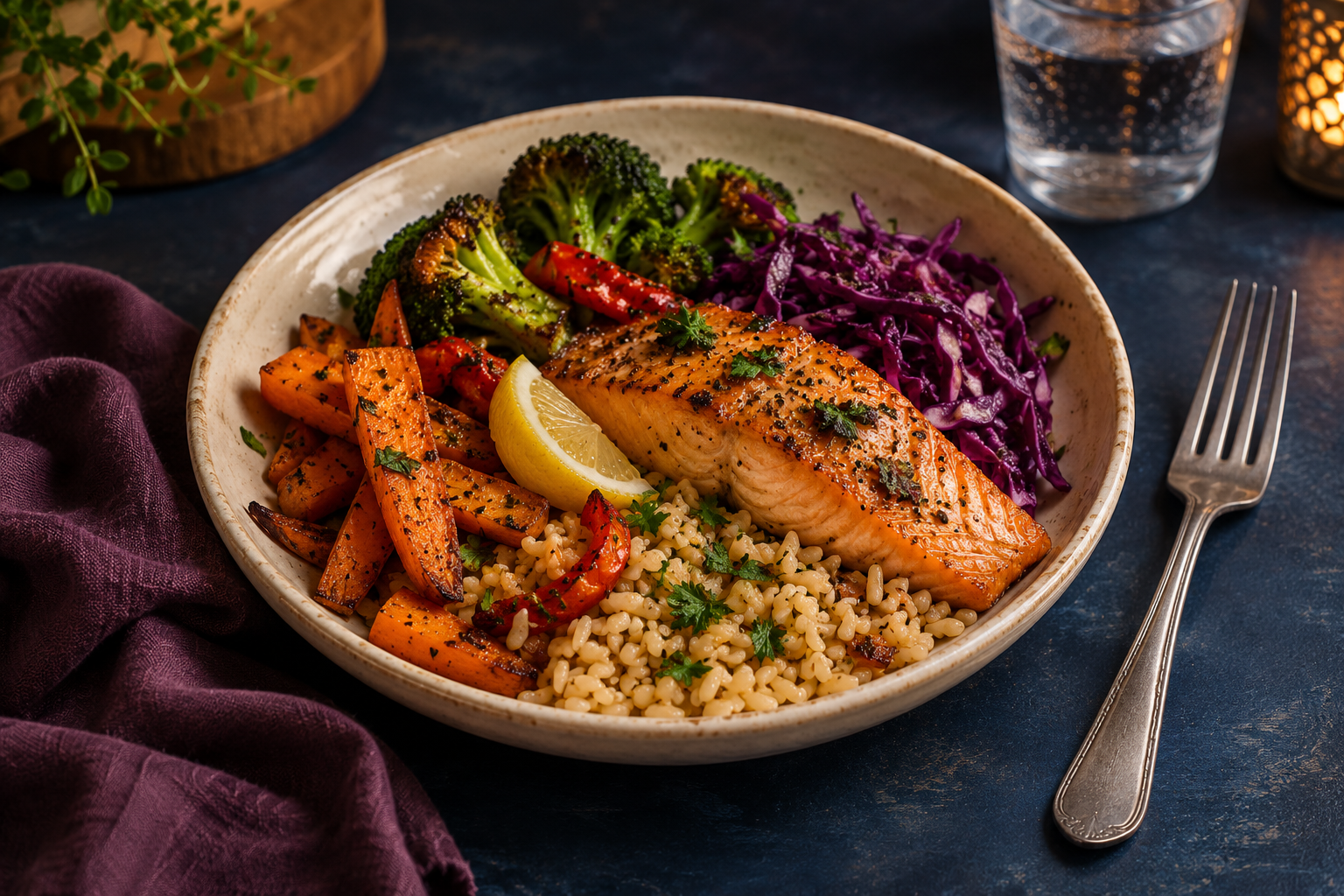
Before we prescribe emergency chicken
Protein belongs in a conversation about fullness. It just doesn’t explain every food decision that happens afterwards.
In a small controlled trial involving 17 women following energy-restricted diets, the higher-protein diet improved reported fullness. It did not significantly reduce energy consumed from freely available carbohydrate- and fat-rich foods on the subsequent test day.[4]
That finding applies to the study’s participants and conditions, but it illustrates a useful distinction: improved fullness and reduced later intake are separate outcomes.
If your meals contain very little protein, including a source you enjoy is worth considering as part of a broader meal review. Eggs, fish, meat, yogurt, tofu, beans, and lentils offer different possibilities.
But if dinner already satisfies you and you still fancy something sweet, you don’t have to assume it failed. A desire for chocolate is not a request for emergency chicken.
The aim of a satisfying meal isn’t to render you immune to the sight of cake. Expecting that makes ordinary food enjoyment look suspicious when it doesn’t need to be.
A better question in front of the cupboard
If you keep finding yourself in the kitchen, begin with what you can notice.
Are you still hungry, comfortably full, or uncomfortably full? Is there a particular food you want? Would eating it feel good now, or would you rather have it later?
You don’t have to answer perfectly. The purpose is to understand the decision, rather than make yourself qualify for a snack.
Naming the food can help. “I want chocolate” gives you somewhere to start. Eating several unrelated things while hoping one of them becomes chocolate may leave the original question unresolved.
You can have some, save it, or realise you want more dinner after all. Your response can match the situation.
What I’d avoid is using willingness to eat leftovers or an apple as a test of whether hunger counts. Refusing one particular food doesn’t provide enough information to decide what someone needs.
It’s also worth noticing how quickly a question becomes an accusation. “Would I enjoy dessert?” asks about a food. “Why can’t I control myself?” makes a judgment before you’ve worked out what’s happening.
The first leaves room for a useful answer. The second makes standing in your own kitchen unnecessarily unpleasant.
When it deserves a closer look
Persistent, unusual hunger is different from being interested in dessert.
If your appetite changes noticeably, particularly alongside increased thirst, frequent urination, or unexplained weight loss, speak with a healthcare professional. Those symptoms can occur with diabetes and warrant assessment.[5]
Eating that repeatedly feels out of control or causes distress also deserves support. You don’t have to settle on a diagnosis before asking for help.
Cortex Takeaway
Feeling full doesn’t necessarily make every other food unappealing. Sensory-specific satiety helps explain why your interest in dinner can fade while a different food retains its charm.
That’s different from meals consistently leaving you hungry. Look at the pattern before deciding what needs to change.
Sometimes dinner needs adjusting. Sometimes you want dessert. Neither situation requires a character assessment in front of the fridge.
Still wondering?
Why do I want dessert when I’m already full?
One possible contributor is sensory-specific satiety: the food you’ve eaten loses appeal relative to foods you haven’t eaten. That helps explain why a different food can remain attractive after you’ve had enough of dinner. It isn’t a complete explanation for every dessert craving.[1]
Does wanting dessert mean I didn’t eat enough protein?
No. Wanting dessert alone cannot establish that. In one small trial, higher protein improved reported fullness without significantly reducing later energy intake from freely available carbohydrate- and fat-rich foods.[4]
Should I ignore hunger because I’ve already eaten?
Having eaten doesn’t establish whether a meal was enough for you. If you’re regularly hungry after meals, consider their size and composition and seek individual guidance if needed. Persistent or unusual appetite changes deserve assessment.
References
- Rolls BJ, Rolls ET, Rowe EA, Sweeney K. Sensory specific satiety in man. Physiology & Behavior. 1981;27(1):137–142.
- National Institute of Diabetes and Digestive and Kidney Diseases. Your digestive system & how it works.
- Cunningham PM, Rolls BJ. The satiation framework: Exploring processes that contribute to satiation. Physiology & Behavior. 2021;236:113419.
- Gwin JA, Maki KC, Leidy HJ. Increased protein consumption during the day from an energy-restricted diet augments satiety but does not reduce daily fat or carbohydrate intake on a free-living test day in overweight women. Journal of Nutrition. 2017;147(12):2338–2346.
- National Institute of Diabetes and Digestive and Kidney Diseases. Symptoms & causes of diabetes.
This article provides general education, not individual medical or nutrition advice. Everyday examples illustrate possible experiences; they are not diagnostic tests or treatments. Images are AI-generated editorial illustrations.